

Psychological well-being and sleep quality among healthy stool donors in Singapore
Psychological well-being and sleep quality among healthy stool donors in Singapore: a cross-sectional study
Toh, T. S., Lee, J. W. J., Toh, K. Y., Ho, J. P., Lim, J. F. Y., Tan, A. H., Chong, C. W., et al. (2021). IDDF2021-ABS-0165: Psychological well-being and sleep quality among healthy stool donors in Singapore: A cross-sectional study. Gut, 70(Suppl. 2), A50–A51. https://doi.org/10.1136/gutjnl-2021-IDDF.48
Background Psychological stress, which is associated with poor sleep quality, has a profound effect on the gut microbiome. To better elucidate the gut microbiome changes associated with psychological stress, we measured levels of stress and sleep quality among the healthy stool donors recruited through a national campaign, and further assessed their relationship with the gut microbiome.
Methods The gut microbial composition of 272 adults residing in Singapore was determined by 16S rRNA V3-V4 amplicon sequencing. Stress and distress levels of participants were assessed using the Perceived Stress Scale (PSS) and Kessler Psychological Distress Scale (K10) respectively, while sleep quality was assessed using the Pittsburgh Sleep Quality Index (PSQI). Multivariate statistical data analyses were conducted to explore the link between the gut microbiome, stress, distress and sleep quality.
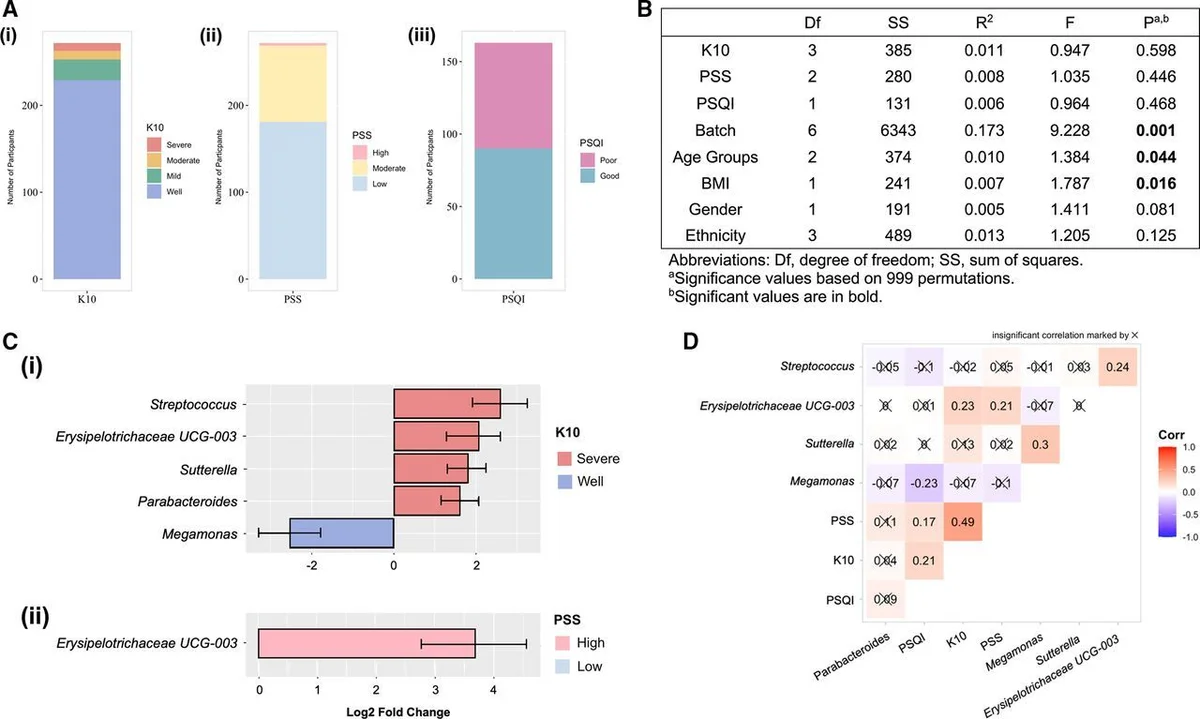
Results A significant proportion of stool donors exhibited low distress (84.2%) levels. However, nearly one-third of participants reported high-stress levels (33.5%) and poor sleep quality (44.8%) (IDDF2021-ABS-0165 Figure A. Stacked bar plot showing the number of participants under each category of (i) K10 , (ii) PSS and (iii) PSQI). The overall variation in the gut microbiome composition amongst stool donors was predominantly dependent on age and body mass index (BMI), rather than psychosocial stress and sleep quality (IDDF2021-ABS-0165 Figure B. PERMANOVA results of main factors in this study). However, four microbial features (i.e., Streptococcus, Erysipelotrichaceae UCG-003, Sutterella and Parabacteroides) were found to be positively associated with severe distress, of which Erysipelotrichaceae UCG-003 was more abundant in both distressed and stressed donors (DESeq2, p<0.05; (IDDF2021-ABS-0165 Figure C. Bar plot showing differentially abundant genera identified between individuals falling under (i) severe (red) vs. well (blue) category of distress and (ii) high (pink) vs. low (light blue - not detected) stress)). Besides, the abundance of Megamonas in the gut was negatively correlated with PSQI after covariates (i.e., age and BMI) adjustment (IDDF2021-ABS-0165 Figure D. Correlation matrix showing the association between differentially abundant bacterial genera and K10, PSS and PSQI categories after covariates adjustment (based on Pearson’s correlation; p<0.05)), suggesting the lowered abundance of Megamonas observed in distressed individuals may be related to their sleep quality.