

A Microbial Signature Risk Score for the Prediction of Hepatocellular Carcinoma
A Microbial Signature Risk Score for the Prediction of Hepatocellular Carcinoma
Nah, K. Y. B., Lee, G. H., Lim, L., Toh, K., Lee, J. W. J., Lim, J., & Chow, P. (2023, December 6–9). A microbial signature risk score for the prediction of hepatocellular carcinoma [Oral presentation abstract, OP-129]. Asian Pacific Digestive Week 2023, Bangkok, Thailand. Journal of Gastroenterology and Hepatology, 38(Suppl. 3), abstract OP-129
Objectives: Only 20% of hepatocellular carcinomas (HCC) are diagnosed at an early stage, making early detection an urgent, unmet healthcare need. We hypothesize the gut microbiome impacts HCC development. We aim to study the microbiome taxonomic and functional features associated with subsequent HCC, such as to develop accurate microbial-based diagnostics for early HCC.
Materials and Methods: We included baseline stool samples collected from 54 patients in our prospective study cohort. Participants subsequently underwent 6-monthly HCC screening with ultrasound and blood tests. Stool metagenomic taxonomic and functional profiles were generated using the bioBakery meta'omics workflow, generating 515 microbial species (166 genera), 482 metaCYC pathways and 2419 annotated Enzyme Commission features for downstream analysis. Linear models were used to identify putative differential abundance analysis of all microbial omic measurement types, whereby each feature was modeled as a function of subsequent HCC, while adjusting for age, body mass index, sex, history of hepatitis, and concomitant cirrhosis.
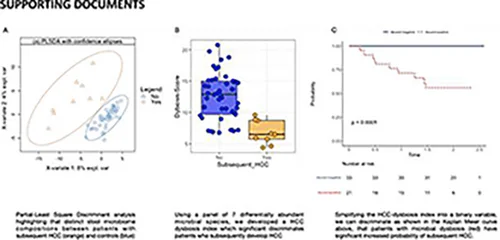
Results: Within 3 years, nine patients were diagnosed with HCC. We identified seven microbial species and 15 microbial enzymes associated with early HCC (P < 0.05,FDR < 0.05), including an increased abundance of Enterococcus faecalis, a lower abundance of Eubacterium hallii, and decreased microbial potential for glutamine synthase, an enzyme essential to maintain low, nontoxic ammonia levels. An HCC-dysbiosis index was developed using the seven microbial species, which significantly discriminates patients with subsequent HCC.
Conclusion: Our results show that the gut microbiota of patients who subsequently develop HCC are significantly distinct. The HCC-dysbiosis index developed is a promising prognostic marker for subsequent HCC.