Asian Microbiome Discovery: AMILI’s genome-resolved metagenomic analysis platform
10th Microbiome R&D and Business Collaboration (2025)
By Amili team
Updated 8 May 2025 · 2 min read


Chang, Y.-J., Tan, S. C., Watcharapichat, P., Lee, J., & Lim, J. (2025). Asian microbiome discovery: AMILI's genome-resolved metagenomic analysis platform [Poster presentation]. 10th Microbiome R&D and Business Collaboration Congress.
INTRODUCTION
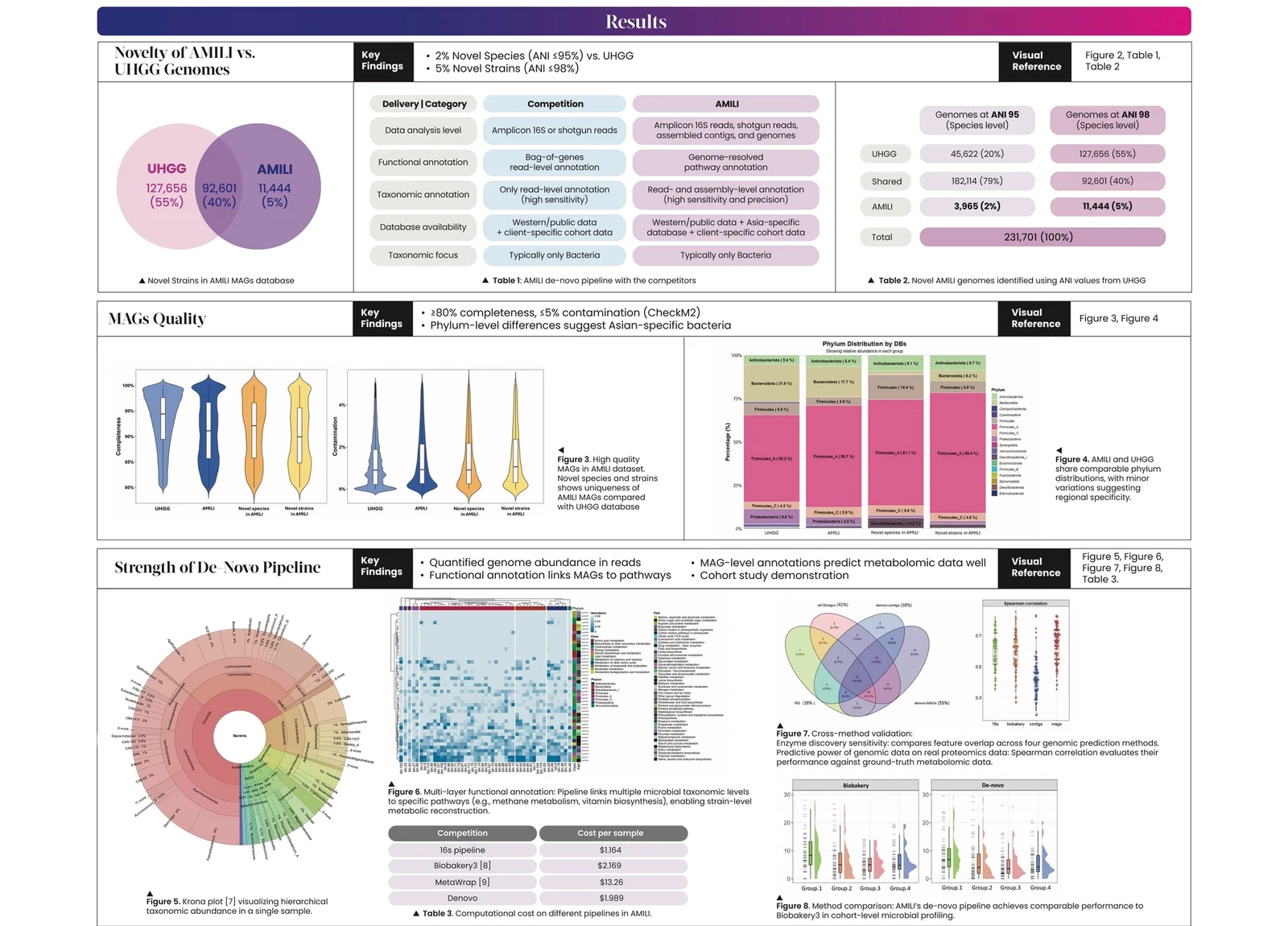
De novo sequencing enables the discovery of novel genes and regulatory regions without relying on reference genomes - essential for studying underrepresented species In this study, we applied high-throughput sequencing to stool samples from Southern Asian individuals and developed a custom pipeline for quality control, assembly, binning, and annotation of metagenome-assembled genomes (MAGs). Our preprocessing steps included read trimming and human DNA removal. We used flexible assemblers to generate contigs, followed by binning to construct MAGs. Taxonomic annotation was performed using GTDB-Tk [1] with a hashed-fragment method. The resulting MAGs showed high quality, with ≥80% completeness and <5% contamination. Functional annotation identified key biological pathways, some of which were validated against known databases (Fig. 1). Despite challenges like assembly gaps and read-length bias, our pipeline effectively uncovered novel species and strains. This highlights the potential of de novo sequencing for microbiome discovery and underscores the importance of continuous pipeline optimisation.
OBJECTIVE
- Develop a comprehensive MAGs database from Southern Asian metagenomes.
- Develop a cost-effective pipeline that preserves MAG quality while lightening computational burden.
- Highlight MAG quality through high completeness, low contamination, and strong overall reliability.
METHODS
Sample Collection
- Collected stool metagenomes from 1,220 Southern Asian participants, mainly from Singapore.
Performed high-throughput Illumina sequencing (AMILI Pte Ltd).
De Novo pipeline design
- Assembly: Short reads assembled into contigs using efficient assemblers.
- Binning: Contigs grouped into MAGs using binning tools.
- Quality Assessment: MAGs evaluated using CheckM2 [2] and QUAST [3].
- Post-processing
- Irredundant MAG dataset generation.
- Taxonomic and functional annotation.
- Abundance quantification using BWA [4] and Sourmash [5].
Pipeline evaluation
- MAG novelty assessed against the UHGG database [6], predominantly based on Western populations.
- Average Nucleotide Identity (ANI):
- <98% ANI: defines novel strains.
- <95% ANI: defines novel species specific to Southern Asia.
RESULTS AND KEY FINDINGS
Novelty of AMILI vs. UHGG Genomes
- 2% Novel Species (ANI <95%) vs. UHGG
- 5% Novel Strains (ANI <98%) vs. UHGG
MAGs Quality
- ≥80% completeness, <5% contamination (CheckM2)
- Phylum-level differences suggest Asian-specific bacteria. AMILI and UHGG share comparable phylum distributions, with minor variations suggesting regional specificity. Phylum categories shown include:
- Bacteroidota
- Bacillota
- Proteobacteria
- Actinomycetota
- Verrucomicrobiota
- Fusobacteriota
- Spirochaetota
- Cyanobacteriota
- Others
Strength of De-Novo Pipeline
- Quantified genome abundance in reads
- Functional annotation links MAGs to pathways. Pipeline links multiple microbial taxonomic levels to specific pathways (e.g. methane metabolism, vitamin biosynthesis), enabling strain-level metabolic reconstruction.
- MAG-level annotations predict metabolomic data well
- Cohort study demonstration. AMILI's de-novo pipeline achieves comparable performance to Biobakery3 in cohort-level microbial profiling.
This article is for general information and does not replace advice from your doctor. Speak to a healthcare professional before making changes to your treatment.
Written
Written by
Amili team